Showing posts with label protection. Show all posts

Wednesday, November 28, 2018

It's Water-Wise Wednesdays with Frannie the Fish! {#TBT: Let's Keep Winter Clean!}

It looks like winter is finally here to stay! Have fun, stay warm, and enjoy this post from last year on how to be a good steward of the earth while staying safe on the slippery sidewalks.


With so much snow and ice on the ground, it’s important that we stay safe on our way to work or school.  Many cities use big trucks carry loads of salt and sand to spread on the roads and sidewalks.  This mixture melts ice and prevents it from forming again so that we can travel around without slipping.


Once the ice is melted, though, the water mixes with the salt and the runoff can cause the groundwater and surface water to become contaminated.  Here’s some ways you can help limit contamination from your home this winter.

1. Shovel early and shovel often. Frannie thinks its fun to shovel snow when it's not too thick and heavy.

2. To limit salt pollution, don't use too much salt or ice-melt. You only need about a handful for each square yard of concrete and using more doesn't actually work better.

3. Sand and kitty litter can stop you from slipping, but they don't melt snow.  Too much of it can even clog sewers, so remember to sweep up and throw away any extra that is left after the ice is gone.

4. Try an eco-friendly alternative to ice-melt and sand such as cracked corn, alfalfa meal, or beet juice.  While you should still be careful not to over-use them, these ingredients are shown to be less harmful than traditional ice treatments.

We can have fun, stay safe, AND keep winter clean together!

Wednesday, May 31, 2017

It’s Water-Wise Wednesdays with Frannie the Fish! {Awesome Aquifer Kit: Improperly Abandoned Well}

This week in Frannie’s exploration of the Awesome Aquifer Kit is all about why you should properly seal abandoned and unused wells.

Did you know that 42 million people in the United States use a private, or individual well to provide water for their families?  But as cities grow and develop, more and more people are turning to municipal systems to get clean, treated water directly to their faucets.  An unused well is basically a direct line for contaminants to enter the groundwater, so it is very important that, if a well is going to be decommissioned, then a well contractor should be called to seal it properly.

But what actually happens if a well is not sealed properly?

In rural areas, such as homes on or near farms, an open well can be contaminated with animal waste, fertilizers, and pesticides.  After a rain, runoff may simply pick up these dangerous chemicals and flow right over the open will, depositing them into the groundwater supply.   If a well is dug deep enough and is connected to other water supply sources in the area, it could contaminate large sections of the aquifers and prevent many other people in the area from being able to access clean water.

Forgotten wells are a big problem too.  Well casings may rust or break down and, even without the help of any outside contaminants, pollute the groundwater.
Wells that are dug, instead of drilled, are typically shallow enough not to majorly affect groundwater quality.  However, if these wells are not sealed properly, their wide shape may cause unsuspecting people and animals to fall into them and injure themselves.

To learn more about wells and to find out where you can go to test and protect yours, visit The Groundwater Foundation's Wells and Wellhead Protection webpages. 

Wednesday, February 15, 2017

BLOG: Get Ready for Earth Day With These River Cleanup Tips

by Katina Hazimhalis, Budget Dumpster


Nearly every community has a nearby waterway, whether a river, lake, bay or creek. Unfortunately, these areas tend to be litter magnets. In fact, nearly 40% of U.S. rivers have been declared too polluted for swimming, fishing or other recreational activities.

Individual people are responsible for creating the trash that clogs our waterways, and it’s often up to individual people to clean that trash up. By hosting a river cleanup project in your area, you can improve the health of your local waterway while also improving community morale – and maybe even inspiring other cleanup projects.

Answer These 4 Questions to Plan a River Cleanup Event

Hosting a successful river cleanup project requires as much planning as elbow grease. Here are the questions you’ll need to answer to get your project off the ground:

1. Where will the cleanup take place?

The first step in planning a river cleanup project is choosing a location. While this may seem straightforward, there are several factors to evaluate before making a final call:
  • What’s the state of your waterway? You’ll want to scout out the trashiest location in order to make the biggest impact.
  • What’s the accessibility? You need a location with multiple access points so that all volunteers are able to participate. Your cleanup location should not be near dangerous rapids or extremely deep water.
  • What’s the water level? In most areas, late spring and fall are the best times for a river cleanup since water levels will be lower, leaving more litter within easy each.

2. How will we find volunteers?

A river cleanup makes a great volunteer activity for scout troops, civic organizations or clubs of any kind. But if you don’t have an established group of volunteers, you’ll have to decide how to get the word out. The first step is to create listings for the event on volunteer meetup sites and/or Facebook. But there are plenty of other methods you can use, like utilizing Facebook ads, alerting local media outlets or approaching local environmental groups.

3. Will we need permits?

If your river cleanup will take place entirely on public property, such as within a park, then no permit is needed. However, if your cleanup will cross over onto private or city-owned property, you’ll need to track down the owners and get their written permission before the cleanup. While this can take time and effort, it’s extremely important to do your due diligence when it comes to gaining permission.

4. What will we do with the trash?

Once the cleanup is complete, you’ll want to make sure that all the trash you collected ends up in the right place. Find out what kind of recycling services are available in your area and, if possible, make a plan to separate recyclables from the rest of the trash. For the remaining debris, you’ll need to find out whether the city will provide trash collection for your river cleanup. If not, you’ll need to either rent a dumpster or find a volunteer with a pickup truck to haul the trash to the landfill.

Here’s to healthier rivers!


Katina Hazimihalis is a content writer for Budget Dumpster. Reach her at katinah@budgetdumpster.com. This post was adapted from Budget Dumpster’s River Cleanup Guide. Check out the full guide for in-depth, start-to-finish advice on planning a river cleanup event, covering everything from advertising your cleanup to securing the necessary permits.

Wednesday, January 25, 2017

It's Water-Wise Wednesdays with Frannie the Fish! {Let's Keep Winter Clean!}

Brrrr!!!

With so much snow and ice on the ground, it’s important that we stay safe on our way to work or school.  Many cities use big trucks carry loads of salt and sand to spread on the roads and sidewalks.  This mixture melts ice and prevents it from forming again so that we can travel around without slipping.


Once the ice is melted, though, the water mixes with the salt and the runoff can cause the groundwater and surface water to become contaminated.  Here’s some ways you can help limit contamination from your home this winter.

1. Shovel early and shovel often. Frannie thinks its fun to shovel snow when it's not too thick and heavy.

2. To limit salt pollution, don't use too much salt or ice-melt. You only need about a handful for each square yard of concrete and using more doesn't actually work better.

3. Sand and kitty litter can stop you from slipping, but they don't melt snow.  Too much of it can even clog sewers, so remember to sweep up and throw away any extra that is left after the ice is gone.

4. Try an eco-friendly alternative to ice-melt and sand such as cracked corn, alfalfa meal, or beet juice.  While you should still be careful not to over-use them, these ingredients are shown to be less harmful than traditional ice treatments.

We can have fun, stay safe, AND keep winter clean together!

Monday, September 26, 2016

BLOG: Protecting Groundwater Through Personal Contact and Best Management Practices

by Chris Barnett, Executive Director, Lawrence Community Development Corporation, Lawrence, Indiana

Indianapolis-Marion County, Indiana has been a Groundwater Guardian Community since 1998.  We recognized the value of The Groundwater Foundation’s programs even before that:  in the early 1990s, when the original team was helping to write our first Wellfield Protection Zoning Ordinance, the Foundation was able to provide us with examples of ordinances and regulations from other communities.

Our team is an all-volunteer board, which is legally structured as a 501c3 not-for-profit “supporting organization” to city-county government.  We contract with an environmental consulting firm to take care of two main responsibilities:  keeping a registry of the “potential contaminant sources” (commercial locations that use and store potential contaminants) in our seven wellfield protection areas, and working with those businesses to employ best practices and minimize risks to the water supply.  Our third main responsibility, which the board undertakes in cooperation with our consultant, is providing speakers and task force members to advise citizens and city-county government on a wide range of topics around groundwater protection.  Our association with The Groundwater Foundation and our long-time Groundwater Guardian recognition adds credibility to our message.  We highlight our Guardian status in presentations, reports, our website, and the printed materials we distribute to businesses.

Our universe is large.  Marion County is an urbanized county of approximately 400 square miles with an estimated population of 939,000.  The vast majority of residences and commercial establishments are served by the municipal water systems of Citizens Water, Lawrence Utilities, and Speedway Water Works.  The rest utilize private wells.  The City of Lawrence and its 47,000 residents are 100% groundwater-dependent.  The Town of Speedway, home to about 13,000 residents and the Indianapolis Motor Speedway, switches from part-surface to all-groundwater in winter when its surface water source becomes unreliable.  About 20-25% of Citizens Water production is groundwater, and that figure is growing with population and new connections.

Our program is voluntary and advisory, as local zoning ordinances can impose design and construction requirements but not operating requirements on businesses.  So our audience is generally limited to commercial/industrial property owners and operators, as well as city government and public health officials.   We stress personal contact and utilizing best management practices to reduce groundwater contamination risk within our wellfield protection districts.


The wellfield districts are set by ordinance as the 5-year time of travel zones around the public water supply wells in the county.  The wellfields encompass about 15% of the county’s land area.  On the map above, the 5-year TOT boundary is the white area; the dark gray area is the 1-year TOT.  Within these areas, there are 2,645 non-residential sites.  About half of the sites are judged to pose little or no risk to groundwater; 696 properties are regulated (or formerly-regulated) sites, and 681 more are unregulated but have commercial operations that could potentially pose a threat to groundwater.  Tracking the commercial uses and maintaining the registry database is a large undertaking, as is the effort to establish face-to-face communication with those businesses.

MCWEC consultant John Mundell addresses the
Riverside Area Superfund informational meeting.
Earlier in 2016, MCWEC directors and consultants mobilized to help organize and present information in a community meeting to address a proposed Superfund site in the midst of a high-production wellfield area.  Historic contamination suspected to be from commercial or industrial uses has been detected in raw water samples at production wells of Citizens Water.  The Indiana Department of Environmental Management worked with USEPA to study the issue, and the result was a proposed Superfund NPL designation.  Such designation in a drinking water protection area overlaid with a combination of residences and businesses carries both advantages and disadvantages.  We believe that the information presented by MCWEC helped community members who were present to better understand how they might respond to the proposed designation.

__________

Chris Barnett is the Executive Director of the Lawrence Community Development Corporation, as well as the team leader for the Indianapolis-Marion County Groundwater Guardian Team, the Marion County Wellfield Education Corporation. Chris also serves on The Groundwater Foundation's board of directors. Reach Chris at cbarnett.lcdc@gmail.com.

The views expressed in this blog are those of the authors and do not necessarily represent the view of The Groundwater Foundation, its board of directors, or individual members.

Thursday, February 11, 2016

How We View Water


By: Anthony Lowndes, The Groundwater Foundation

With close to half of the United States relying on groundwater for drinking water, it is important to ensure a sustainable supply. In Nebraska, it’s close to 85 percent. The 2015 Statewide Groundwater-Level Monitoring Report indicates that Nebraska’s groundwater supplies are on the rebound. Aside from subsiding drought conditions and heavy rainfall, the implementation of technological advances in irrigation have reduced water consumption. On the domestic water use side, public awareness and the installation of water saving appliances has helped lower demand.

But quantity is not the only issue facing Nebraska, or any other area. While drought often causes increases in the amount of water withdrawn from the ground resulting in declines, contamination can ruin an entire source of water. There are several contaminants highlighted in the 2015 Nebraska Groundwater Quality Monitoring Report that are not so unique to Nebraska, such as nitrates and uranium. We need to continue to think critically and creatively when it comes to protecting water sources.

In several states, communities can proactively develop local protection measures for source water through Wellhead Protection programs. For the 43 million Americans who supply their own water through a private well, be sure to have your well tested on a regular basis and check with your local USGS office about potential contamination concerns.

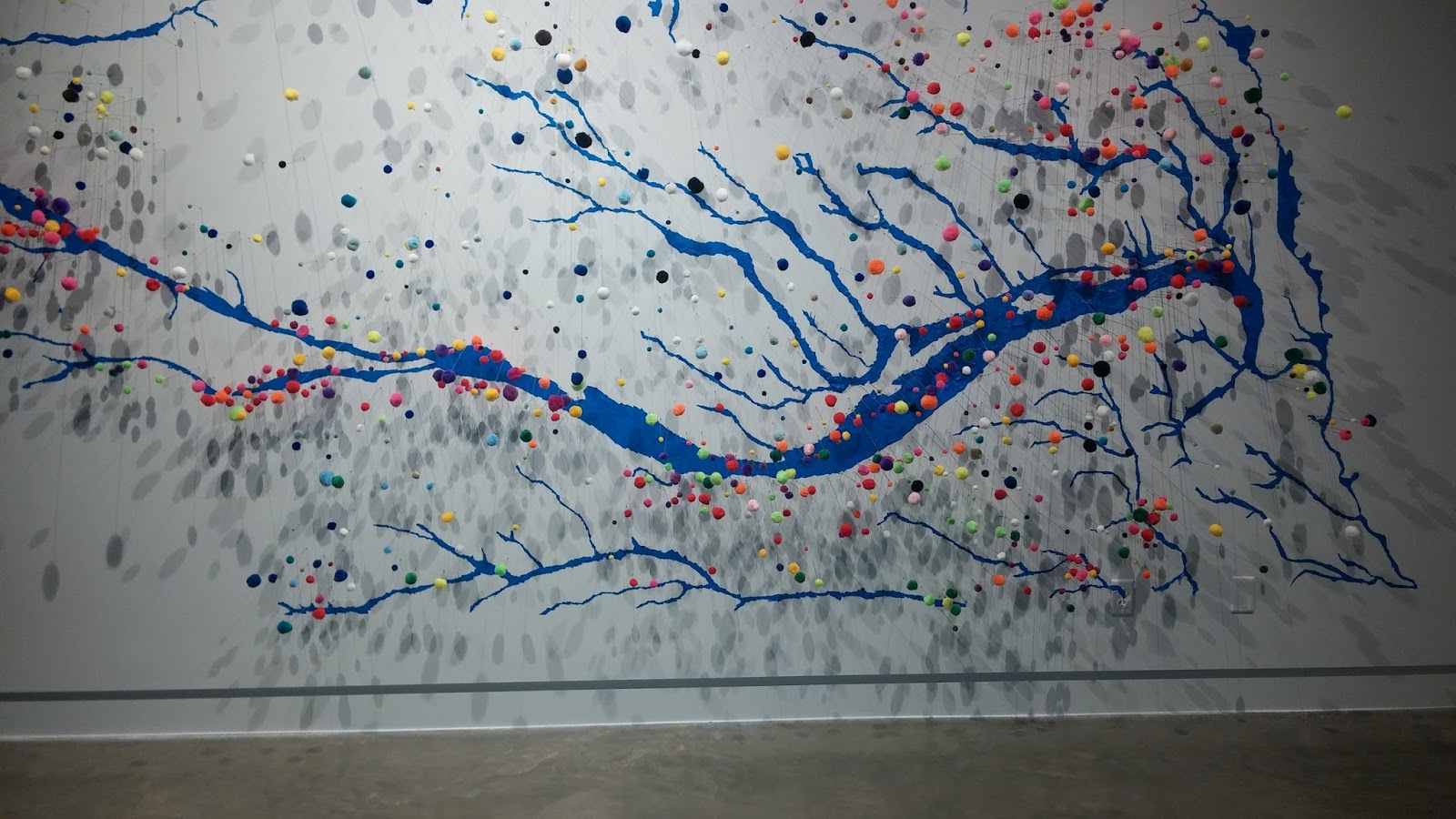
Water issues can be shared through a wide variety of mediums. For example, Kaneko, a public non-profit cultural organization in Omaha, NE, is currently exploring water issues in the Midwest and around the world through a variety of research and technological innovations and fine art displays, drawing the viewer into the world of water. One particular exhibit caught my eye. It is a to-scale outline of Nebraska that is over eight feet tall. The data points from the Quality Monitoring Report are represented by pompoms and color coded for each type of contaminant. Another is a fantastic artistic rendition of a combine and center pivot circling an enormous water drop.

Creating ways for people to visualize a resource that is often taken for granted is the goal of both the reports and the K
aneko Water exhibit. Find out more about water in your area and get involved in conserving and protecting it.

Thursday, January 21, 2016

Recognizing Groundwater Guardians

By Jessica Wheeler, The Groundwater Foundation

The Groundwater Guardian program has been a staple of The Groundwater Foundation since 1994 and represents a network of communities and organizations acting locally to educate people and protect and conserve groundwater.  The program offers many benefits:
  • The program provides communities of all types (cities, counties, watersheds, schools, etc.) a framework for local action, providing structure and support for long-term action.
  • Earning Groundwater Guardian status sets your community apart - it draws positive attention to efforts to ensure a viable water supply.
  • Guardians have access to a variety of resources to help with local efforts, including a wealth of online tools.
  • Communities are recognized nationally and locally by The Groundwater Foundation for their efforts to educate the public and protect groundwater.

I am thrilled to honor the 72 Groundwater Guardian Communities and Affiliates that protected the groundwater of over 18 million people and earned designation for 2015!  This group represents 24 states and a wide variety of activities and approaches to groundwater protection.  From hosting groundwater festivals to holding cleanups of local waterways to participating in household hazardous waste collection and all the activities in between, these Guardians are dedicated to protecting our most precious resource.

Groundwater Guardians and Groundwater Guardian Green Sites recognized at The Groundwater Foundation's 2015 National Conference in Lincoln, Nebraska on October 21, 2015.

I am so excited to see what is in store for our Guardians, both new and old, in 2016.  Learn more and become a Groundwater Guardian today!