Wednesday, May 17, 2017

It’s Water-Wise Wednesdays with Frannie the Fish! {Awesome Aquifer Kit: Sinkholes}

This week in Frannie’s exploration of the Awesome Aquifer Kit is about sinkholes and how they are formed.

A sinkhole is a hole in the ground caused by the erosion of the soil or bedrock underneath.  They occur when acidic water seeps down and percolates through soluble, or easily dissolved, layers of soil like sandstone, chalk, or limestone.  Over hundreds or thousands of years, more of the rock dissolves while loose soil and sand shifts down to fill the cracks.  For a long time, the land is able to hold its own weight and even the weight of buildings constructed on top of it.  However, as even more of the rock dissolves and becomes empty space, the land becomes too heavy and will collapse suddenly.
For this activity, you will need a pitcher of warm water, sand,
a piece of paper, a cup with a small-medium size hole,
a coffee filter, scissors, and sugar or powdered creamer.
To observe this in our aquifer kits, we’ll start by collecting our materials: a cup, sand, sugar, a paper tube, a pair of scissors, and a coffee filter or sponge.

Frannie starts by cutting a small hole, the same width as the tube, in the bottom of the cup and placing the coffee filter on top of it, keeping it in place with just a little bit of sand.

Next, she puts her tube over the coffee filter and fills the tube a part of the way with sugar.  The sugar represents the soluble rock that will dissolve when the ground gets wet.  While the tube is still in the cup, she pours in the sand so that it comes to about the same height as the sugar.  The sand represents the rest of the ground and will hold the soluble layer in place.


Slowly remove the tube without disturbing the sand or sugar too much and then pour more sand on top, just enough so that none of the sugar is showing.  Carefully pick up the cup and place the bottom into the water and in just a few moments, the water will infiltrate the sand and sugar, dissolving the sugar and creating our sinkhole.

Check out this cool graphic to see what's happening inside the cup!

Graphic by PBS

Wednesday, May 3, 2017

It's Water-Wise Wednesdays with Frannie the Fish! [Awesome Aquifer Kit: Erosion and Weathering}

This week in Frannie’s exploration of the Awesome Aquifer Kit is all about the concept of erosion and weathering.

Photo credit: howtosmile.org
Weathering is the slow destruction or wearing away of soil or rock which is followed by the process of erosion, where the broken particles are then carried away.  This is a very important concept for groundwater and it can happen in two ways: mechanical weathering or chemical weathering.

Mechanical weathering is when rock or soil is physically broken down by constant exposure to flowing or moving water.

Imagine a river that’s moving quickly, picking up sand from the beaches and carrying it downstream.  That’s an example of the beach being mechanically broken by the stream, which carries the sand downstream and makes those beaches smaller.  The same thing can happen underground where, as water slowly flows and picks up particles of soil or rock, the land might get worn down and even sink slightly. 
 
Photo credit: USGS
If the sinking of the land occurs over a long period of time, we call that subsidence.

Chemical weathering is when the rock or soil mixes with the water and dissolves to become a new substance.

This usually happens when polluted rain seeps down into a carbonate type of bed rock.  The acidic water comes into contact with the basic soil and changes the chemistry of the rock so that it breaks down and forms new particles that move with the water flow.


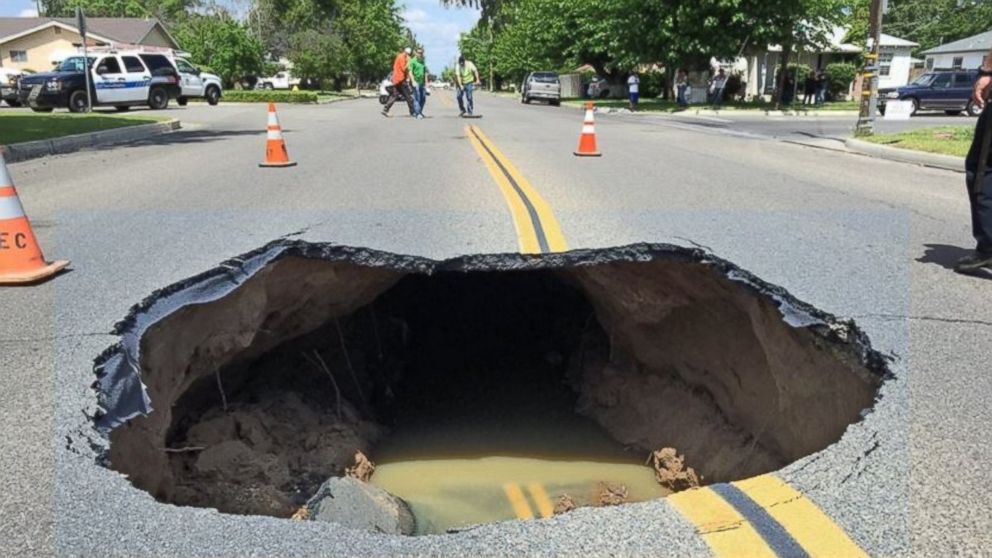
Photo credit: ABC News
It is this kind of weathering and erosion that is usually the cause of sinkholes, a type of sudden natural disaster that results with a large hole in the ground.  Frannie will show us more about sinkholes next week.

BLOG: How Much Do You Know?

by Jane Griffin, The Groundwater Foundation

Next week (May 7-13) is Drinking Water Week. About half of us in the United States drink groundwater, but how much do you know about it? Take this short quiz to test your knowledge (answer key at the end of post):

1. Groundwater is:
        a. The water on the earth’s surface
        b. The water in the ground
        c. The deepest part of the water in the ocean
        d. The water contained in clouds

2. An aquifer:
        a. Is a geological formation that contains water
        b. Can be confined
        c. Is below the earth’s surface
        d. All of the above

3. When an aquifer is replenished it is called:
        a. Recharge
        b. Discharge
        c. Water table
        d. Saturated zone

4. The Ogallala is part of the:
        a. Edwards Aquifer
        b. Hawaiian Aquifer
        c. High Plains Aquifer
        d. Central Valley aquifer system

5. Groundwater is used for:
        a. Drinking water
        b. Irrigation
        c. Industrial use
        d. All of the above

How’d you do? 

There's a lot to learn about groundwater. Why not have some fun learning with our hands-on activities? Check out our Activities Library to find something that's right for you.

Do you want more quizzes about groundwater? Download our free Water1der mobile app and get your fill of groundwater trivia. See how much water you use in a day with our free water tracking app, 30by30, and find ways to use less water.

Get involved in local groundwater protection and education with a local Groundwater Guardian team. Is there one near you? Find out. If there's no team in your area, be a sparkplug and get one started - here's how.

Groundwater - it's the water many of us drink. Think about it during Drinking Water Week, and get yourself started on knowing more about this magical resource and involved in protecting it for future generations!

ANSWER KEY: 1. B, 2. D, 3. A, 4. C, 5. D

Tuesday, April 25, 2017

BLOG: Developing Science Literacy Through Environmental Education

by the WELS2 Project Team (Tina Vo, Cory Forbes, Nick Brozovic, and Jane Griffin)

Around the globe, humans face an array of contemporary challenges associated with food, energy, and water systems. To prepare future generations of problem-solvers equipped to address these challenges, education must go beyond merely disseminating information. The Environmental Protection Agency (EPA), for example, has identified important components of environmental education that include an emphasis on awareness, knowledge and understanding, attitudes, skills, and participation in environmental challenges. When focused on these challenging issues of today, science literacy can involve:
  • Explaining, describing, predicting natural phenomena  
  • Considering multiple viewpoints and different stakeholders invested in the system
  • Identifying issues, biases, or limitations within research
  • Accounting for various mechanisms and their effects within a system 
  • Evaluating the validity of data collection methods
  • Creating and evaluating arguments around environmental topics
  • And a myriad of other science-oriented tasks and practices 
This knowledge and the associated skills define scientific literacy about interactions between humans and the environment. Supporting audiences to become more scientifically literate requires cultivating a culture and perspective that values critical thinking, problem-solving, and informed decision-making.


For example, decisions about water resources are complicated and involve human and environmental concerns.  A scientifically-literate person is one who’s prepared to ask questions such as: Who/what benefits from resource allocation? Who/what might be hurt by these decisions? What evidence do we have to support these claims and how did we obtain that evidence? How will this impact the water availability for others? Have we considered the natural and economic factors will be influenced? And these are only a few aspects to consider. While issues like this are complicated, frameworks like the ones developed at the University of Nebraska help untangle them by providing guidance such as where to start, who to ask for help, and how to educate ourselves.

Another way these key components of environmental education are highlighted and science literacy is supported is through the adaptation of state and national standards that acknowledge the role of ‘science practice’ as a way of doing and knowing science and requesting these practices be taught in the classroom. Teachers can support students through meaningful and directed educational experiences by providing opportunities to develop knowledge about food, energy, and water issues (e.g. water resource management) and scientific practices (e.g. scientific modeling). 

One aspect of environmental education that can prove challenging for learners of all ages centers on the complexity of hydrological phenomena. Complicated environmental issues develop around balancing humans’ use of groundwater against depletion and recharge rates. Supporting and fostering critical thinkers who can find solutions for these multifaceted issues will take dedicated educators who are well versed in science practices and environmental education. 

A program targeted to support these dedicated teachers to provide quality classroom instruction is the WELS2 project. Based at UNL, this project is a collaboration between the UNL Science Literacy Program, Daugherty Water for Food Global Institute, and The Groundwater Foundation. 

The WELS2 project (Water Education Leaders for Secondary Science) is committed to providing high school and middle school teachers in Nebraska with the training, supplemental educational materials, and experiences around hydrological phenomena, to support their food, energy, and water education efforts in the classroom. Through this professional development program, teachers can earn up to 9 hours of graduate course credit through the College of Agricultural Sciences and Natural Resources at the University of Nebraska-Lincoln, as well as a stipend, to support their ongoing professional learning. WELS2 introduces teachers to various resources including computer-based water modeling tools, pedagogical strategies for encouraging students' model-based reasoning about water, and strategies for grounding these experiences in real-world, issues-based contexts. Teachers will learn to use these resources to develop their professional skill sets, as well as how to use them in their classrooms to enhance their students’ learning about water systems. Participating teachers use part of this experience to collaborate with educational specialists and scientists and tailor resources suited to their students’ needs. This collaboration is an important facet of the project which highlights the expertise of the participating teachers to assess and develop materials specifically for their use. If you are interested in joining this program or would like to learn more, please inquire here.

Environmental education is an important part of supporting and developing science literacy in audiences of all ages. Educators who wish to help students develop these tools for critical thinking, reasoning, and problem-solving need to be supported and provided opportunities to do so. By partnering with institutions and organizations like the UNL Science Literacy Program, Daugherty Water for Food Global Institute, and The Groundwater Foundation, educators can leverage additional tools and resources delving deeper into environmental challenges and supporting their students in building critical thinking, problem-solving, and decision-making skills. 

The WELS2 Project Team includes Cory Forbes, Associate Professor of Science Education, Institute of Agriculture and Natural Resources Science Literacy at the University of Nebraska-Lincoln, cory.forbes@unl.edu; Tina Vo, PhD Candidate, University of Nebraska-Lincoln, ms.tinavo@gmail.com; Nick Brozovic, Director of Policy, Robert B. Daugherty Water for Food Global Institute, nbrozovic2@unl.edu; and Jane Griffin, President, The Groundwater Foundation, jgriffin@groundwater.org.