Showing posts with label water well contractor. Show all posts

Wednesday, January 8, 2020

BLOG: Choosing a Water Well Professional

A qualified water well contractor is vital for proper construction, maintenance, and necessary repairs of your well system. There are many things to consider, questions to ask, and job components to compare before choosing the right contractor for your system:

1. Contractor Qualifications

  • Is the contractor licensed by the state? (Not all states require licensing.)
  • Is the contractor certified through the National Ground Water Association or a member of NGWA? 
  • Does the contractor submit well logs?
  • Does the contractor have adequate equipment in good condition to do the job?
  • Does the contractor have adequate liability and workers’ compensation insurance to protect you? 
  • Is the contractor familiar with applicable health and safety codes?
  • What is the contractor’s reputation with previous customers?
  • Will the contractor furnish a written contract specifying the terms and conditions of the job?

2. A Written Contract
It's important to have a written contract with the water well professional when preparing to have a well constructed. Unless you know what each contractor will do for his specified price, you cannot compare offers and decide which one to hire. For a drilled well, the contract might include:

  • Liability insurance coverage held by both the owner and the contractor
  • A statement that all work is to comply with local and state regulations and codes
  • The diameter and well thickness of the casing to be used
  • The type of well development and yield evaluation procedures to be used
  • The type of screen to be installed, where needed
  • The type of well cap or seal to be provided
  • The disinfection procedure
  • The cleanup after drilling, which includes all material abandoned without authorization at a drill site except drill cuttings and wastewater
  • An anticipated date for start of drilling
  • A guarantee of materials and workmanship (the contract should specify that the contractor will return to do or to correct the initial work if necessary)

3. Estimated Costs
An itemized list of charges is better than a lump sum for easy comparison. The list could include:

  • Cost of drilling per foot
  • Cost of casing per foot
  • Cost of other materials such as drive shoe, grout, and well cap
  • Cost of other operations such as grouting, developing (if longer than one hour, as in screened wells), test pumping, and disinfection
  • Cost of drilling deeper and/or second well, if required to ensure an adequate water supply
  • Cost of abandonment should it prove necessary (for instance, if saltwater is encountered and another site is selected)
  • What costs are not included in the specifications.

4. Post-Construction Checklist
After the well has been constructed and before the contractor removes his equipment from the site, you should check the well for:

  • Well Depth—This is easily done by tying a weight on a tape. Verify the measurement against the well construction report made out by the contractor.
  • Well Yield—Ask the contractor at how many gallons per minute (gpm) the well was tested, what distance the water level dropped during the test, and how quickly the water level recovered after the test.
  • Well Cap—Ensure that the well is capped and secure and that the cap is at least 6 inches above ground level.
  • Disinfection—Ask the contractor if the well was disinfected.
  • Well Construction Record—Make certain that you receive your copy of the well record. The contractor is required to deliver copies of the record to the owner. It would be advisable to keep your well record with your house deed so that the information is passed on to future owners.

Other Things to Keep in Mind . . .

  • The contractor is the expert, not you. Trust the contractor’s judgment in solving unforeseen difficulties that may come up, and discuss unforeseen costs.
  • If original construction plans must be changed, discuss the options with the contractor.
  • Don’t expect the contractor to work for free if the well does not fulfill expectations.
Use the National Ground Water Association's Contractor Lookup tool to find a contractor in your area!

Adapted from Wellowner.org.

Friday, November 1, 2019

BLOG: Easy Tips for Protecting Your Well, Your Water, and Your Wallet This Winter.

The cooler weather and pumpkin pies can be a welcome change from the summer heat, but it also means one looming fact: winter is coming.

While many of the water well systems in the northern U.S. are required to be built under the frost line, there is a large section of the South and Midwest where pumping systems are constructed above ground or above the frost line. For these systems, it’s important to take steps to keep your well safe and operating through the winter.

1. Get Your Well Inspected
NGWA and Wellowner.org recommend an annual inspection of your water well system. If you haven't had your inspection done, scheduling before the winter weather arrives could save you a lot of time and money! Find a qualified contractor.

2. Protect Your Pump
Many well systems are buried deep underground, which provides protection from the cold. But for well owners with above ground pumps, action should be taken to keep the system insulated and warm. Constructing a small insulated enclosure covering the pump will help keep the system above 32 degrees and reduce the risk of freezing and other damage. This small “well house” can save thousands of dollars in repairs and ensure a well operates throughout a cold winter. Find a qualified contractor.

3. Protect Your Pipes
As water freezes, it expands and can burst your pipes, leading to significant damage to your home and well. Frozen pipes are a common winter issue for homeowners, but can be avoided with a few easy steps. 
  • Turn off your exterior water and blow out your pipes. Ideally your house will have a shut-off valve for its exterior water supply. If so, turn off any water that flows to outside irrigation systems and faucets. Once you have turned the water off, then drain the remaining water or use an air compressor to blow out the pipes. If you don't have a shut-off valve, find a local contractor for other options to shutting off exterior water.
  • Insulate your pipes. For houses with piping that runs through non-heated spaces like basements, we suggest insulating pipes. Wrapping pipes with rubber casings or fiberglass insulation can keep their temperature above freezing and the water flowing.
  • Inspect your pipes. This is a great time to do a general inspection of your water system and piping. Spotting a problem in your system now could save you from a costly problem this winter. Find a certified contractor to schedule an inspection.

4. Prepare for a Power Outage 
While there is little that can be done by the homeowner to prevent power outages due to winter weather, there are steps to take so you have water to drink while waiting for the lights to come back on.
  • Always have a portable gas generator and plenty of gas to connect to your pumping system.
  • Stock up on bottled water before the winter; this way if there is a prolonged outage, you can still have clean drinking water in the house.
  • Contact a local contractor to learn more about backup generators and other options to keep your water flowing during a power outage.
Adapted from wellowner.org.

Friday, August 30, 2019

BLOG: The Importance of Well Owner Maintenance Practices

Routine maintenance and inspection of water wells can help protect water quality, ensure your well is operating properly, prolong the life of the well system, and protect your investment. Greatest of all
these is the protection of groundwater and your health, as water quality issues can have adverse health impacts without any detectable indicators.

Small problems can often be identified by performing maintenance before they become costly, inconvenient situations. It’s similar to routine maintenance on your vehicle—if you have the oil changed at specified intervals, the engine will operate reliably much longer than if you don’t.

At a minimum, wells should be evaluated annually by a licensed or certified water well systems professional and include a flow test; visual inspection; a water quality test for coliform and anaerobic bacteria, nitrates, and anything else of local concern; checking valves; and electrical testing.

You should receive a written report following the annual checkup that describes recommendations and all laboratory and other test results. Keep this with all other well information.

Understanding Your System
Well owners should have a basic understanding of their well system. Start by maintaining records of any well logs. A detailed log of your well’s construction and the pump installation record are two important tools in troubleshooting and potentially fixing issues with your well and well pump in the future. Ask your well contractor for these records. A well log can provide information regarding the depth of the well, the type of casing used, grouting practices and intervals, static water levels, what type of pump test was performed and results, if the well is screened or not, and more.

You should also be aware of any filtration or treatment systems. Know if one is installed, what type of treatment method is used, and what the water is being treated for. Read the owner’s manual and  keep a copy with your well records for when an issue arises.

Visual Inspection
Well owners should also conduct a regular visual inspection of the well to monitor its performance.

  • On the wellhead, inspect the casing’s general condition and if it extends at least 12 inches above ground. The well cap on top of the casing should be securely attached. Verify that any electrical connections are secure.
  • Survey the area above ground surrounding the well. Check the location relative to potential sources of contamination, flooding, and physical dangers. Maintain at least 50 feet between the well and any kennels, pastures, feeding areas, or livestock operations, and ensure a proper distance is maintained from buildings, waste systems, or chemical storage areas (including fuel tanks). Be sure the ground surrounding the wellhead is sloping away from the well to divert surface runoff.
  • Any growth of weeds, trees, shrubs, or grasses with root systems within 10 feet of the well should be physically removed. Avoid the use of chemicals or herbicides near the wellhead. 
  • The well should not be in a roadway or driveway. If it is within close proximity to a roadway or driveway, it should be properly marked to avoid being hit by vehicles. Be conscious of any other potential threats to the wellhead—garages, ATVs, sledding hills, debris, dirt, surface water, fuels and chemicals (including fertilizers), and runoff water from kennels, pastures, or feedlots. 
  • Well owners should visually inspect any above-ground pumping equipment. Ensure motors are  properly cooled and vented, check for shaft seal leaks, and rust or other signs of weakened fittings.
  • Examine other above-ground well system wiring and parts such as pipes, connections, joint seals, gauges, pressure relief valves, and the water meter (if present). A water sample tap should be located near the pressure tank, high enough to easily collect a water sample.
  • Note the condition and accessibility of above- and below-ground storage tanks. Evaluate the condition of the control box and connections. Maintain water softeners, conditioners, and filtration equipment.

When to Call a Professional
A qualified water well professional should be consulted for any issues discovered during a visual inspection. When in doubt, call a water well systems professional, but especially:

  • Anytime the well has to be opened (cap or well seal removed). 
  • If you experience taste or odor problems.
  • If you experience turbidity or cloudiness (“dirty” looking)
  • If there is a loss of capacity or pressure—the well is not producing as much water as previously produced, the pressure drops and surges, or the pump cycles on and off frequently. 
  • If a test is positive for total coliforms, anaerobic bacteria, or any positive test results indicating a potential health concern. 
  • If you find defects with your wellhead, the wellhead area, or the overall water system during your routine inspection.

Cleaning and disinfection should only be performed by a qualified water well systems professional—for your safety and the protection of your well system.

Find out more about proper well maintenance and much more online at www.wellowner.org.

Friday, May 31, 2019

BLOG: McEllhiney Lecture Series in Water Well Technology

William A. McEllhiney
The William A. McEllhiney Distinguished Lecture Series in Water Well Technology was established National Ground Water Association, and a groundwater contractor and civil engineer.
in 2000 to foster professional excellence in water well technology. The lecture series honors William A. McEllhiney, the 1948 founding president of the

Each year, a panel of groundwater contractors invites an outstanding groundwater professional to share his or her insights and work experiences with the industry. The Groundwater Foundation is pleased to have Jeffrey Williams, MGWC, CVCLD, as the 2020 McEllhiney Lecturer.

Requests to host the 2020 lecture are now open! If you're interested in hosting a lecture, complete and submit the request form to be considered for a McEllhiney Lecture host.

Jeff Williams
2020 Lecturer: Jeffrey Williams
Jeffrey (Jeff) Williams, MGWC; CVCLD began his career in the groundwater industry with his first full-time job at Spafford and Sons in Jericho, Vermont, in June 1980.  He and his father purchased that company in 1984. Jeff’s experience has been varied both in water well supply and geothermal heat pump operations. Like all water well supply contractors and one involved in a family business, he understands first-hand the challenges of working with a resource that consumers can’t see until it is brought to the surface, the immediate business impacts of regional and national economic conditions, and the critical need to plan for all types of contingencies. He became active in NGWA in 2006 as a member of the Safety Subcommittee and as a director candidate. He served on the NGWA Board and was association president in 2016. Jeff and his wife Carol Ann enjoy boating and family activities.

Williams' lecture for 2020 is titled "Running a Business or Doing a Job: Combining Professional Expertise with Business Savvy."
You are a business owner, or you are responsible for running a company. Have you made the mental transition from viewing your business as a series of individual jobs or as an entity offering a pallet of groundwater services? If you have any plans and goals for diversification, they require capital as well. Kudos to those who have, but this is not an easy journey mentally, financially, or emotionally. If your primary benchmark is how much you are charging per foot or for one water system installation, then you need to start the transition now. How do you begin thinking big picture and setting financial and production goals? What are the benchmarks? How do you manage equipment, time, and human and financial resources better? Are you planning your business model to include training, certifications, licensing and equipment replacement? And how do you bring others involved in the company in this much broader and more goal- oriented transformation. Just getting by isn’t an option—just like hoping to win the lottery is an unrealistic retirement plan. Planning and managing for greater profitability will determine the state of your business in the future.

For more information about the McEllhiney Lecture, including a current schedule of presentations for the 2019 lecturer, Gary Hix, check the Groundwater Foundation's website.

Friday, April 5, 2019

BLOG: Request a Free Well Owners Guide

Do you have a water well? Do you know someone who has a water well? If so, make sure you get a copy of the Well Owners Guide.

The Guide is a comprehensive information piece for consumers with nearly everything you could ever want to know about water wells.

Packed with detailed, easy-to-understand information, the Guide addresses:

  • Well construction
  • Well maintenance
  • Water testing
  • Water treatment
  • Groundwater protection

The guide takes consumers step-by-step through getting a well drilled, hiring a qualified groundwater professional, how wells work, following a maintenance schedule, abandoning old wells, how to get the well water tested, options for water treatment for various contaminants, and how well owners can protect groundwater.

If you want more information, check out Wellowner.org.

Contact Aaron Martin at the National Ground Water Association to request your free copy of the Well
Owners Guide today. Call 1-800-551-7379 extension 1564 or email amartin@ngwa.org.

Thursday, January 10, 2019

BLOG: Seven Ways to Maintain Your Private Well

by Jennifer Wemhoff, Groundwater Foundation

Well maintenance is an important part of protecting groundwater. For a private well owner, understanding and practicing the basics of regular well maintenance can reduce the risks to the water supply as well as money by preventing costly maintenance issues.

Here are seven ways to maintain your well:

1. Never try to service your own well.
It's always best to contact a professional water well contractor - they use specialized equipment, materials, and techniques to keep your water safe and well system up and running. A homeowner who attempts to service their well in some way may accidentally introduce contamination into the well, drop objects into the well, or cause damage to the pump. It's always a best practice to use a professional!

2. Regular maintenance costs less.
It's much better to catch and address a small issue with a well system early before it turns into a much larger and much more expensive issue.

3. Learn what a well check-up or service should include.
A well maintenance check should include a flow test to determine system output (along with a check of the well's water level before and during pumping, pump motor performance, and general water quality), an inspection of the well equipment, and a test of the water for bacteria and nitrates (and any other potential contaminant of local concern). You should also receive a written report detailing the check-up that explains results, recommendations, and test results.

4. Maintain your well on an ongoing basis.
Check out this Homeowner Checklist from WellOwner.org for ways you can protect your well and groundwater every day - doing things like keeping chemicals far away from your well, sloping the ground away from your well for drainage when landscaping, and keeping your well records in a safe place.

5. Use qualified professionals.
When your well needs attention or inspection, find a qualified professional to do the job. Use this handy tool to find a certified contractor near you.

6. Ask questions and understand the problem.
Don't be afraid to ask questions of the well contractor. It's their job to help you understand what's going on and help you find ways to correct the issue. You'll get a better understanding of how your well system works and what happened to cause the problem in the first place.

7. Find old, unused wells on your property.
Abandoned wells should be properly sealed by a professional - not only do they provide a direct pathway for contaminants to enter an aquifer, they're also a safety issue, particularly abandoned hand-dug wells that are large enough to fall into. Find out more about old, unused wells.

Find out more about wells and well maintenance, and remember that maintaining a private well is the well owner's job!

Adapted from WellOwner.org.

Friday, October 5, 2018

BLOG: Protect and Prepare Your Well for Flooding

Heavy rainfall events are becoming more and more common, triggering devastating flooding. Hurricanes and strong thunderstorms have dumped massive amounts of rain on many parts of the U.S. recently, and experts fear it's getting worse.

If you're a well owner, you need to be prepared to deal with keeping your well safe before, during, and after flood and storm events.

1. Prepare, Prepare, Prepare
When a storm is imminent, take some time to protect your wellhead and pump if they're exposed to the elements. Covering or securing them can help protect them from any flying debris. If you don't have a surge suppressor on your pump, now is a good time to add one. Power surges during and after storms can damage a well's electrical components. Also, it's a good idea to fill your tub and sinks with water before the storm - if you lose power this water can be used to wash hands and flush toilets - as well as stock up on bottled water for drinking.

2. Ride Out the Storm
If your well loses power during the storm, make sure you turn off the pump at the circuit breaker and leave it off through the duration of the storm. Power outages can result in spikes/surges which can damage the well's components. Stay away from the well during the storm to avoid electrical shock.

3. After the Rain
If you didn't have any flooding, examine your well equipment for damage. If you see any damage, contact a professional before you attempt to turn on or operate the pump.

If your property has flooding, you'll want to be extra cautious. Do not turn on the power! Don't go near it for your safety and to avoid electrical shock. Wait until the water has receded before you approach the well. Don't drink the water or use it for cooking or washing - use an alternative source like bottled water. Get in touch with a qualified water well contractor or pump installer to get your well up and going.

Adapted from Wellowner.org's Hurricane/Flooding Resources

Friday, September 1, 2017

BLOG: Protect Your Groundwater Day is September 5


If you are a private water well owner, there are many ways to protect your water quality. Two of the most important are:

1. To make sure your well is properly capped, and 
2. To properly plug any abandoned wells on your property. 

That’s why the 2017 theme for Protect Your Groundwater Day, on Tuesday, September 5, is “Cap It, Plug It!” 

Why is this so important? A water well provides a direct connection between the what’s above the ground and groundwater in the subsurface. 

If an active water well is not properly capped—or if an abandoned well is not properly plugged—it can create a direct pathway for contamination in the same groundwater you and others use for their drinking water supply. 

If you own a household well, you are responsible for making sure that your well is properly capped and any abandoned wells on your property are properly plugged. 

What makes a properly capped water well? First, not just any covering will do on top of the well casing, that vertical pipe that extends above the ground in your well. A proper well cap should: 
• Be bolted or locked, so that it cannot be easily removed, 
• Have a rubber seal to prevent anything from infiltrating the well where the cap is joined to the well casing, 
• Be in good condition. 

A tight-fitting well cap that is not bolted or locked can be jarred loose or removed by someone other than the well owner. Also, a well cap that lacks a rubber seal or is cracked or otherwise broken can allow bugs, vermin, bacteria or other types of contaminants above the ground surface into the well.

 Well caps should be installed by a water well system professional, and any well cap maintenance or replacement should be done by a professional. Also, a well system should be disinfected when a well cap is installed, repaired, or replaced. 

How do I properly plug an abandoned well? First, the challenge is to find abandoned wells on your property. Some abandoned wells are obvious while others are not. Survey your property for: 
• Pipes sticking out of the ground. 
• Small buildings that may have been a well house. 
• Depressions in the ground. 
• The presence of concrete vaults or pits. 
• Out-of-use windmills. 

Other tips for finding old, abandoned wells can be found in: 
• Old maps, property plans or property title documents. 
• Neighbors. 
• Additions to an old home that might cover up an abandoned well. 

A water well system professional may do additional checking—including a records check—for more information about abandoned wells. 

A water well system professional should always plug an abandoned well using proper techniques, equipment, and materials. The professional should: • Remove all material from the well that may hinder proper plugging. 
• Disinfect the well. 
• Then plug the well using a specialized grout that (1) keeps surface water from working its way into the borehole, and (2) prevents water from different subsurface levels from mixing. 

The cost to plug a well depends on factors including: 
• The depth and diameter of the well 
• The geology of the area 
• Accessibility to the well, and 
• The condition of the well. 

For more information, please visit www.ngwa.org.

Friday, November 11, 2016

BLOG: A Day in the Life of a Water Well Contactor

by Lee Orton, Nebraska Well Drillers Association and Groundwater Foundation Board Member

The day of a water well contractor varies. But every two years, licensed Nebraska water well contractors are required to take 12 hours of continuing education. The Nebraska Well Drillers Association puts on various seminars, workshops and outdoor classes through the two-year cycle.  

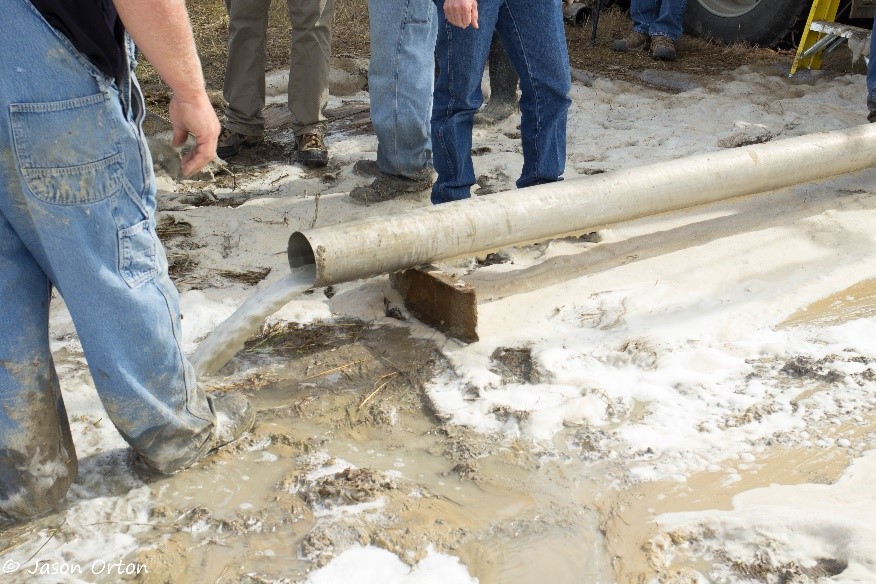
In 2016, one of the days of a water well contractor was spent at a class held just outside of Lincoln, Nebraska on land owned by the Lower Platte South Natural Resources District (LPSNRD), the local water resources management district. The class was done through a joint effort of the Nebraska Well Drillers Association, LPSNRD,  Baroid, Nebraska Heath and Human Services, drill manufacturer Gefco, and member drilling contractor Downey Drilling.  

The day included a well being drilled using an air foam concept. In this drilling process, a foam mix is placed into the well as the drill proceeds down. The foam then brings the cuttings up and out of the well. The foam mix proved to be a method to be used when conditions require something other than a traditional mud drilling medium due to special material geology or other characteristic because of environmental conditions. Unfortunately, the water was not usable due to high salt content. It was planned to be used to water livestock, but the water quality meant the well had to be decommissioned. 

The day was a learning experience either way.


About the Author 
Lee Orton's entire professional career has been established and directed to service for clients involved in water resources professions. His early work with the State of Nebraska related to water resources planning. His clients represent a wide range of groundwater professionals, and working with them for over four decades has demonstrated to him the real importance of public education about groundwater.