Showing posts with label nebraska wellhead protection network. Show all posts

Friday, September 27, 2019

BLOG: Emergency Management and Drinking Water Protection Workshop

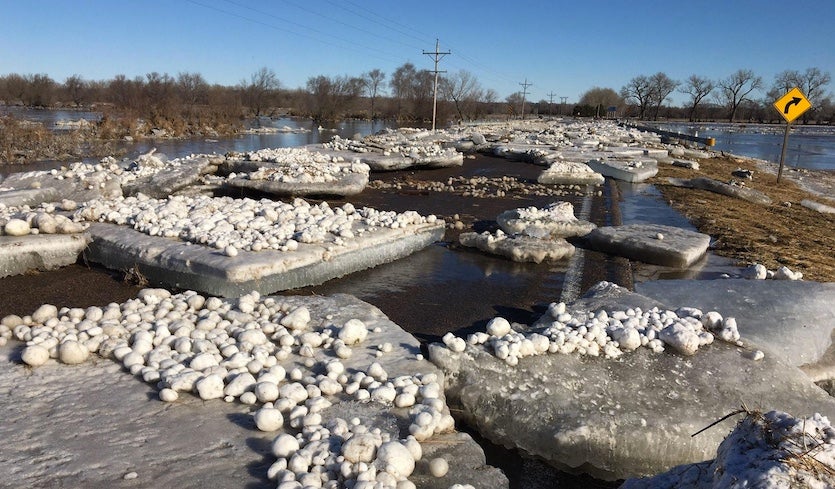
The effects of the historic flooding Nebraska experienced this spring are still being felt all these months later, and will continue to be felt into the future. A natural disaster such as this is a good opportunity to look at contingency planning for community drinking water supplies in the event of an emergency.

Image credit: Nebraska State Patrol

The Nebraska Wellhead Protection Network is hosting a workshop on the subject October 3, 2019 from 9:00 a.m. to 4:30 p.m. at Valley Irrigation (28800 Ida Street, Valley, Nebraska) and invites you to join us. "Emergency Management and Contingency Planning to Protect Nebraska's Water Supply" will cover:

  • Why having a comprehensive emergency management plan is important
  • How to develop an emergency management plan
  • Stories of how towns and businesses survived Nebraska's flooding this spring
The agenda includes:
Lunch and a tour of Valley's facilities, which were impacted by spring flooding, are generously provided by Valley Irrigation.

Join us and help your community be prepared for emergencies! Register by October 1.


Questions? Contact the Groundwater Foundation at info@groundwater.org or 402-434-2740.

Friday, June 28, 2019

BLOG: Project GROW and Wellhead Protection

by Sara Brock, Groundwater Foundation

The Nebraska Wellhead Protection Network (WHPN) met on Thursday, June 27 at the Upper Big Blue Natural Resources District offices in York, Nebraska.

Much of the meeting focused on Upper Big Blue NRD's Project GROW (Growing Rotational crops On Wellfields). Upper Big Blue Water Conservationist Dan Leininger and Site Manager/Farmer Scott Gonnerman talked about the method of planting and harvesting cover crops as well as the soil and water health benefits they have seen as a result. Notably, they have increased water infiltration rates from 0.5 inches/hour to over 6 inches/hour, significantly reducing runoff. They have also been able to decrease their need for applied nitrogen, saving themselves money and protecting water quality at the same time. Department Manager Marie Krausnick briefly touched on a Source Water Grant and collaboration with the City of York that makes Project GROW possible.


The meeting concluded with a tour of the Project GROW site, which is located on the City of York’s wellfield. Visiting the soybean field, WHPN members saw leafy rows peaking out that had been shielded from the previous night’s hail by the triticale stalks that covered the field.


The pollinator habitat, opposite the soybeans, looked grassy and healthy. At two years old, it’s still filtering out some of the chemicals that have been added to the soil over the years, but it will grow bigger and have more blooms as the soil health is restored.

The tour ended at the community garden, a space that is open to members of the public to grow their own fresh produce. Using what they’ve learned from the Upper Big Blue NRD staff and Project GROW, York residents are growing tomatoes, zucchini, and more. The NRD also put in a couple rows of fruit trees and bushes that, in a few years, will be open to harvest by the public.


Attendees represented several state and local organizations such as the Nebraska Departments of Environmental Quality and Department of Health and Human Services, several Natural Resources Districts, and community utilities. 


Click here to learn more about Project GROW. Click here to learn more about the Nebraska Wellhead Protection Network.

Friday, September 28, 2018

BLOG: Nebraska Wellhead Protection Network

by Sara Brock, The Groundwater Foundation

The Nebraska Wellhead Protection Network is a collaboration of the Groundwater Foundation, state agencies, local municipalities, and private organizations who are involved in protecting and conserving groundwater and drinking water sources in Nebraska. A recent meeting was held on September 26, 2018 at the Water Treatment Plant in Auburn, Nebraska. Ken Swanson, manager of Auburn’s Water and Wastewater Treatment, and Dave Hunter, general manager of Auburn Board of Public Works, hosted the 24 of us inside Auburn’s Water Treatment Plant amidst all of the pumps, filters, and equipment.

Auburn’s public water system is supplied by groundwater from the alluvial aquifer underneath the Nemaha River valley and, because of this, is classified as “Groundwater Under the Direct Influence of Surface Water” or GWUDI. Communities that utilize GWUDI as a source have to have additional methods and treatments to ensure that the water that enters the public system meets all drinking water standards. The water treatment plant one part of Auburn’s complex and proactive approach to providing clean water in their area.  Fully automated, the plant self-cleans its filters, provides treated and safe water to all of its residents, and was designed to allow for additional filtering tanks and treatment processes should water quality and quantity issues arise in the future. While the filters were turned off during the presentation portion of the meeting, Ken and several of Auburn’s water operators were able to show us how the plant performs a filter flush and backwash during the tour.

Beyond the plant, Auburn has been working closely with the Nebraska Department of Environmental Quality to update their Wellhead Protection (WHP) Plan, including a re-drawing of the boundaries to include the Surface Water Contribution Area, encompassing a whopping 51,000 acres of land in and around Auburn. Dave’s presentation focused very passionately on the idea that groundwater and surface water protections absolutely must be integrated because “they all end up in the same bucket” and the 2017 version of the plan not only reflects this, but has also opened up Auburn’s WHP and Drinking Water Protection Management Plan (DWPMP) to new sources of funding. Auburn is the first municipality in the U.S. to utilize federal 319 funding for an integrated groundwater and surface water management plan.


The complex history and future plans of Auburn’s water system was a useful subject for many of the attendees of this meeting, including representatives from Syracuse, York, and Wilber.  These communities are in the process of developing and implementing wellhead protection and drinking water protection management plans. Talking with Ken and Dave as well as Jonathan Mohr, a senior environmental planner with JEO Consulting Group who assisted in the development of the plans, the meeting provided potential next steps and opportunities to replicate and improve upon Auburn’s WHP model.

For more information about the Nebraska Wellhead Protection Network, visit https://www.groundwater.org/action/community/newhp.html.

Wednesday, January 24, 2018

It's Water-Wise Wednesdays with Frannie the Fish! {Wellhead Protection: Nebraska Wellhead Protection Network}

This is Part 2 in Frannie's exploration of Wellhead Protection.   Read Part 1 here and look for more blogs to learn more about what it is, who protects the wellheads, and why it's important.

----

Wellhead Protection AreaFrannie knows that it takes a lot of teamwork to develop and enforce a Wellhead Protection Area. From members of government to city water operators to customers, everyone has to work together to protect the water supply.

Wells and wellfields are highly influenced by the surface around them. For example, if a community uses too much fertilizer on its lawns or crops, a well has the potential to act as a direct pipeline, funneling the chemicals into the groundwater below.  It’s important for people and agencies to communicate with each other about appropriate strategies for facing groundwater threats.

In Frannie’s home state of Nebraska, a special group meets 3-4 times each year to hold such conversations.  Back in 2001, The Groundwater Foundation, funded by the NebraskaDepartment of Environmental Quality, began to facilitate and record the meetings of the Nebraska Wellhead Protection Network (NeWHPN).  Members include the Nebraska Department ofHealth and Human Services, the 23 Natural Resources Districts in Nebraska, theNebraska Rural Water Association, local water systems and water supply operators as well as other people, businesses, and agencies who are involved with tackling groundwater and drinking water issues.
Nebraska Wellhead Protection Network
Network meetings often cover topics and hot button issues that are requested by and relevant to Nebraska communities facing threats to their groundwater, including nitrate contamination and depletion.   Many meetings include tours of the facilities being discussed or workshops that help network members develop skills that facilitate groundwater education and protection.

If you’d like to read about what the NeWHPN has covered in the past or you’d like to participate in future meetings, check out their page on The Groundwater Foundation’s website.


Wednesday, January 10, 2018

It's Water-Wise Wednesdays with Frannie the Fish! {Wellhead Protection: What is it?}

This is Part 1 in Frannie's exploration of Wellhead Protection.   Look for her upcoming blogs to learn more about what it is, who protects the wellheads, and why it's important.

----

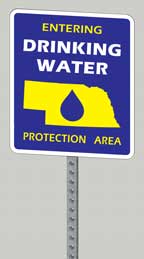
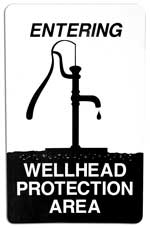
Frannie is learning more and more about how to protect the groundwater in her community.  Recently, she saw a sign just outside of her city that said "Wellhead Protection Area".  She didn't know what that meant, so she went to The Groundwater Foundation's website to find out.
"Wellhead protection" is a fancy term for the idea that we should protect the land around the area where a community gets their water. Many communities use wells to withdraw groundwater and then transport it to a water treatment plant where they treat it and pipe it into the public water system.  Growth and development in a community is important, but it also brings the potential to deplete or contaminate the water everyone drinks.
Each state has a different approach to wellhead protection but will generally involve 5 key points:
1) Delineating the Wellhead Protection Area.  Several maps, containing data on groundwater flow and geology and geographic boundaries, are combined into a single map that determines the land area that could influence the groundwater supply.
2) Conducting a Potential Contaminant Source Inventory. This just means that information is collected about all of the sources in the areas that could potentially contaminate the groundwater.  This may include farms, gardens, factories, or other types of industry.
3) Contaminant Source Management. All of the information that was collected in the Potential Contaminant Source Inventory is put to use to develop best practices where businesses can safely use their materials without threatening the groundwater.
4) Contingency Planning. No wellhead protection plan is complete without a plan for the worst case scenario.  In the event of a well that has to be shut-down due to contamination, natural disaster, physical breakdown, or any other cause, a community must have an idea of short-term and long-term drinking water supply replacements.
5) Education. A community is made up of it's people, so ultimately it is the people in the area who have to protect their water.  A community should make their wellhead protection plan available to the public as well as provide workshops or opportunities on social media for people to learn about the plan.

Thursday, December 28, 2017

BLOG: A Look Back at 2017

by Jennifer Wemhoff, The Groundwater Foundation

As we quickly approach 2018, here's a quick look back at the happenings during 2017 at The Groundwater Foundation.

We debuted a new look! The Groundwater Foundation adopted a new organization logo, replacing the logo that had been in use since the early 1990s. Complementary logos were also created for the Groundwater Guardian and Green Site programs.


Jim Goeke joins the Groundwater Foundation Board of Directors. Jim is a groundwater legend in Nebraska. He spent many years with the University of Nebraska's Conservation and Survey Division, becoming intimately familiar with the Ogallala Aquifer and its water riches.

The 2017 National Conference visited Boise. Boise spoiled us with beautiful fall weather and sunny skies, and the conference was a great opportunity to connect with old and new groundwater friends and peers.


Groundwater Foundation President Jane Griffin was appointed a member of the National Environmental Education Advisory Council (NEEAC). The Council is made up of representatives outside the federal government who provide EPA with advice on environmental education.

We educated over 30 Nebraska educators in an intensive week-long workshop as part of the Water Education Leaders for Secondary Science (WELS2) project with the University of Nebraska-Lincoln.


We continued as an active member of the Nebraska MEDS Coalition. The Coalition works to promote safe drug disposal as part of protecting water supplies and the environment, as well as preventing accidental overdose and abuse. Over 300 pharmacies in Nebraska take unused or expired medications back as part of the program.

The Nebraska Wellhead Protection Network met quarterly throughout 2017, including meetings for state Senators and staff at the Nebraska State Capitol and a tour of a community aquifer storage and restoration project. The Network brings together organizations across Nebraska working on wellhead protection.


Hydrogeology was part of the 30th anniversary of Science Olympiad during May's 2017 National Tournament. Hydrogeology involves simple computer groundwater modeling, and has been adapted for classroom use.

Jack Daniel named 2017 Kremer Award Winner. The retired administrator of the Office of Drinking Water and Environmental Health at the Nebraska Department of Health and Human Services earned the award for his leadership and contributions to the state's groundwater resources.


We're excited for 2018 and want you to be there for everything along the way. Get involved in one of our programs, become a member, and learn more about groundwater!

Wednesday, December 27, 2017

It's Water-Wise Wednesdays with Frannie the Fish! {The Gift of Water}


The end of the year is a good time to reflect on the successes of year as much as the challenges, on what we have lost as much as what we have taken for granted.

Frannie had an amazing 2017 at Girl Scout Camps, nature camps, Science Olympiad, and in Boise at The Groundwater Foundation's National Conference.  She learned a lot about what communities across the United States are doing to take care of their water and she enjoyed sharing what she learned with all of you!

As Frannie turns her thoughts to 2018, she can't forget that there are still people in the United States and abroad who struggle to have access to clean water.  Parts of the Colorado River are running dry and experts fear that Lake Mead, in Arizona, may be gone by 2021, yet many people don't understand why that's the case or how they can make small changes to save water in their communities.

Groundwater is the water we drink and the water we use to grow our food.  Educating ourselves and each other is an important first step in protecting this precious resource.  Over the last year, Frannie has shown you tools and tips to save water at home.  Next year, she wants to take you out into the field to learn about the Nebraska Wellhead Protection Network, Groundwater Guardian Teams, and other programs that you, personally, can take part in.

Even though the holiday season is almost past, giving the gift of water can be done throughout the year in ways as simple as sharing this blog with your friends and family or going to our website to learn more about groundwater.  If your area doesn't have a Groundwater Guardian team, you can start your own and share the magic with your community.

If you would like to see Frannie talk about specific topic or answer your questions in an upcoming blog, please send her an email at info@groundwater.org.  Have a safe and happy new year!

Friday, June 2, 2017

BLOG: Communities and Collaboration: Upcoming Groundwater Foundation Events

by Sara Brock, The Groundwater Foundation

June is an exciting month for The Groundwater Foundation as we bring many of our collaborative projects to fruition.

Working with the Nebraska Department of Environmental Quality (NDEQ) and educators in Western Nebraska, we bring the Recharging Groundwater Education program to a teacher’s workshop in Ogallala. Among the other useful tools teachers can use to enhance student science learning, we’re providing classrooms with Awesome Aquifer Kits and supplementing the traditional curriculum with new and updated activities, worksheets, andtechnologies.

Mid-June is marked by an exciting collaboration with the University of Nebraska – Lincoln and Robert B. Daugherty Water for Food Institute with the WELS2 program. It will bring Nebraska’s science educators the HydrogeologyChallenge program with an emphasis on model-based learning. Participating teachers will use the week to prepare and develop a groundwater curriculum that they will use during the 2017 – 2018 academic year. Understanding the concept of models and the Hydrogeology Challenge through Nebraska’s new College and Career Ready Standards for Science will empower teachers to incorporate groundwater education into their science classes, as well as provide students with a modern environment to learn and boost their problem-solving skills.

Finally, the Nebraska Wellhead Protection Network, another partnership with the Nebraska Department of Environmental Quality, will have its quarterly meeting on June 21st in Hastings, Nebraska.  Beyond sharing updates and ideas for education and outreach programs, attendees will also have the chance to learn about and tour Hastings’ brand new Aquifer Storage and Restoration facility. Begun in July 2016, the nearly-complete project aims to increase drinking water storage and quality and simultaneously reduce the economic burden of clean water on taxpayers. Interested in attending? Register here.