With 1 in 9 people lacking access to safe water, World Water Day 2019 emphasizes the importance of delivering clean, safe water across the globe. What are some of the critical reasons for the lack of access to fresh water globally? What's the importance of a safe water supply? Check out the infographic below from Waterlogic.
__________
Waterlogic provides office a variety of point-of-use water purification and dispensers for businesses.
The views expressed in this blog are those of the author and do not necessarily represent the view of The Groundwater Foundation, its board of directors, or individual members.
Showing posts with label world water crisis. Show all posts
Friday, March 22, 2019
Monday, March 13, 2017
BLOG: #MyWaterStory
by Jennifer Wemhoff, The Groundwater Foundation
Two weeks ago, we were fortunate to connect with the people behind #MyWaterStory.
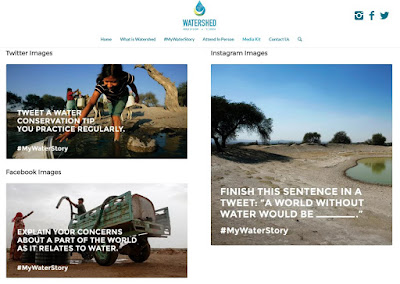
We know that every person has a story, and water has a story. So we were thrilled to get involved with the #MyWaterStory movement.
As they explained it, water stories are personal. Water stories are shared experiences across languages, religions, and geographical locations.
They want to find out: What does water mean to individuals around the world? What role does water play in daily life?
This collection of global water stories will show the world how water affects life, communities, and cultures.
#MyWaterStory is engaging global audiences in a social media conversation leading up to Watershed — the World Water Day activities co-hosted by the Vatican and the Club of Rome on March 22, 2017 — and to inform other water-related events throughout the year.
#MyWaterStory program is designed to help capture and reset the basic understanding around the value and values of water. Where are the values and value strongest, where is the underlying story lacking? And why? It does this by creating new networks, generating inspiring, lasting stories, educating and engaging a younger international audience, and making relevant the urgency for action by policy makers, innovators, and the public.
Through #MyWaterStory, individuals — especially students — around the world share their stories, artistic work, video, or other multimedia content related to the value of water in their lives.
You can upload your own water story on worldwatervalues.org/mywaterstory or share via social media using the hashtag #MyWaterStory.
Check out the website for more information, including:
- Opportunities for people from around to participate in the conversation.
- Six water themes, which each include prompts to respond to through Twitter, Facebook and Instagram using #MyWaterStory.
#MyWaterStory is led by: Circle of Blue, Ball State University, Project WET Foundation, Columbia University, Texas A&M, GWU, UNESCO, UN Water, WWAP, Wilson Center, and other international education networks.
Friday, November 6, 2015
Learning From the Leaders
by Anthony Lowndes, The Groundwater Foundation
It has been two weeks since the conclusion of the 2015 Groundwater Foundation National Conference. As a first-time conference goer, the sheer amount of information to absorb was slightly overwhelming to say the least. After some reflection, I believe there are several very positive messages I received loud and clear.
I have known for a long time that it takes many people to provide safe, clean drinking water to the millions of people in our country, but seeing and meeting so many of them was something entirely different. Some, like me, were new to the world of water while others have been conserving and protecting groundwater for many years. The virtue I most noticed was the passion demonstrated by each person I had the pleasure of talking to. Each of them had a story, long or short, that illustrated how we are all passionately working together to protect the most valuable resource on Earth.
At the Foundation’s 30th anniversary celebration dinner, it was clear that we have many challenges ahead of us, including increased demand for water as our global population grows. It will take current technologies and continued advancement in water conservation and understanding groundwater resources to provide for the expected nine billion people by 2050. Several speakers focused on project successes they have had in exactly these areas.
These are not single issues to be dealt with individually, but rather a comprehensive approach should be used to bring all stakeholders to the table. This approach was successfully used in Israel, illustrated by Naty Barak of Netafim. Combining a clear legal framework with integrated water management, technology and innovation created a sustainable water economy. Technological innovation isn’t just in how we use water, but also how we understand groundwater resources.
In many areas of the world, including eastern Nebraska, the geology of local aquifers can be difficult to pinpoint, thus making it difficult to manage. Lower Platte South Natural Resources District and the UNL Conservation and Survey Division have been utilizing Airborne ElectroMagnetic (AEM) survey technology to increase and build upon data collected from test holes. The advanced survey technique provides a virtual borehole every 150 feet along the flight path. The same technique was also utilized in western Nebraska and can be applied to many different types of aquifers, putting a valuable tool in the hands of geologists and groundwater managers.
Other tools, such as NASA’s Gravity Recovery And Climate Experiment (GRACE) mission, provide information about water availability and demonstrate gains and losses on a much larger scale. Combining all of the tools in our toolbox will provide water managers a way to effectively make policy decisions and continue to provide their communities with safe water. There are still places needing further research. Technology has yet to reach many others, but the huge gains in our understanding and use of groundwater are, in my view, very promising.
The 2015 Conference has inspired me to instill the same passion for groundwater into those I work with as was demonstrated by those who were at the conference. As I help educate those around the state of Nebraska and beyond about groundwater, there will be a certain spring in my step given to me by those I met at the conference. Let’s get started!
Friday, February 20, 2009
"For Love of Water"

By Jennifer Wemhoff, The Groundwater Foundation
I recently saw the documentary “FLOW” (For Love of Water). The film is an “award-winning documentary investigation into what experts label the most important political and environmental issue of the 21st Century - The World Water Crisis. Director Irena Salina builds a case against the growing privatization of the world's dwindling fresh water supply with an unflinching focus on politics, pollution, human rights, and the emergence of a domineering world water cartel. Interviews with scientists and activists intelligently reveal the rapidly building crisis, at both the global and human scale, and the film introduces many of the governmental and corporate culprits behind the water grab, while begging the question "CAN ANYONE REALLY OWN WATER?" (taken from www.flowthefilm.com).
While the film does help viewers understand the fragility and finite nature of our world’s water resources, I would have liked more of a focus on the importance of protecting that resource, rather than pointing fingers at the “governmental and corporate culprits.” I imagine this is because The Groundwater Foundation advocates protection of water resources as paramount to ensure a safe supply for generations to come.
Parts of FLOW left me feeling downhearted and pessimistic about the future of water, while other parts made me grateful for the infrastructure that grants me access to clean water in my home. The film quotes Margaret Mead: “Never doubt that a small group of thoughtful, committed citizens can change the world. Indeed, it is the only thing that ever has.” I think this message of individual and collective impact is empowering, and the part of the film that touched me the most were the stories of individuals and groups who have taken action and helped make access to drinking water a reality in many poor parts of the world.
The film concludes by discussing establishing access to clean water a fundamental human right with the United Nations (see http://www.un.org/Overview/rights.html for the Universal Declaration of Human Rights). A petition is being circulated to add this as Article 31 to the Universal Declaration of Human Rights: “Everyone has the right to clean and accessible water, adequate for the health and well-being of the individual and family, and no one shall be deprived of such access or quality of water due to individual economic circumstance.” (http://article31.org/).
What do you think – Is access to water a fundamental human right? Can anyone really own the water? If you’ve seen FLOW, what were your reactions?
Subscribe to:
Posts (Atom)